Game category
Blackjack
Blackjack is the one casino table game where correct play measurably shrinks the house edge to close to zero – basic strategy, applied consistently, brings most rule sets down to somewhere between 0.3% and 0.7%, lower than almost any other game on the floor. That gap between playing on instinct and playing basic strategy is larger in blackjack than in any other common table game, which is what makes the rules worth learning properly rather than winging it.
This page covers how online blackjack variants differ from each other, what basic strategy actually changes, how side bets and rule variations move the house edge, and what to check before playing a specific variant for real money.
How Table Rules Change the House Edge
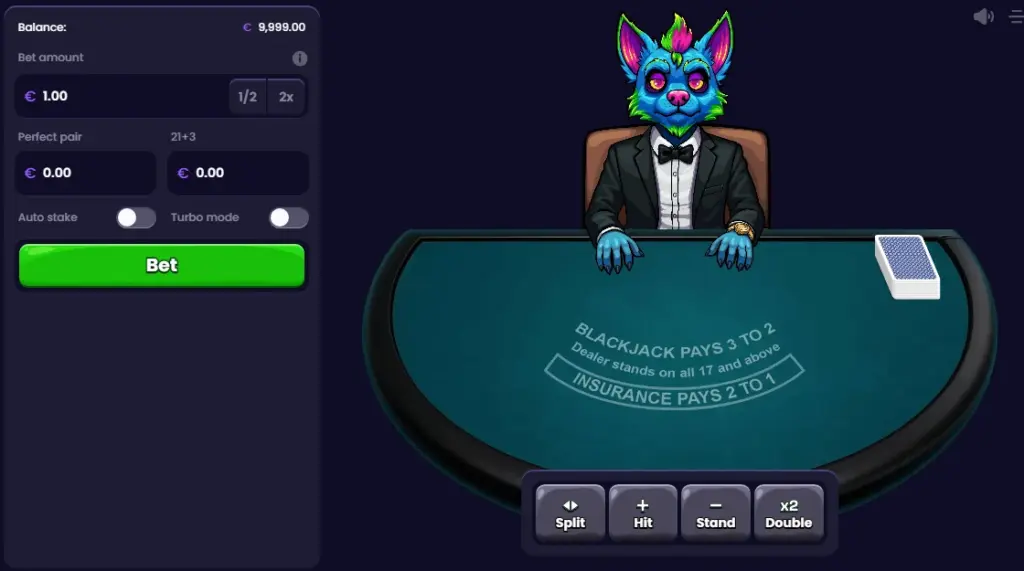
Not all blackjack tables run identical rules, and the differences move the house edge more than most players assume. A handful of rule variations account for most of the swing between a good table and a poor one.
| Rule | Effect on House Edge |
| Blackjack pays 3:2 vs. 6:5 | 6:5 payout adds roughly 1.4% to the house edge |
| Dealer stands on soft 17 vs. hits | Hitting soft 17 adds about 0.2% |
| Double after split allowed | Removes about 0.14% when allowed |
| Number of decks (1 vs. 6–8) | More decks add roughly 0.5%–0.6% versus single deck |
| Surrender available | Removes about 0.05%–0.07% when offered |
A 6:5 blackjack payout is the single largest red flag on this list – it’s common on some single-deck tables specifically because the shorter payout claws back the advantage that fewer decks would otherwise give the player.
Basic Strategy: What It Actually Is
Basic strategy is a fixed decision chart – hit, stand, double, or split – for every possible player hand against every possible dealer upcard, computed to minimise the house edge under a given rule set. It isn’t a system for predicting cards or beating the deck; it’s the mathematically correct response to each situation assuming no knowledge of what’s still in the shoe.
The chart changes slightly depending on table rules – number of decks, whether the dealer hits or stands on soft 17, whether doubling after a split is allowed – which is why a strategy chart built for one rule set isn’t perfectly optimal for another, even though the overall shape stays similar.
Hard Totals
Hands without an ace, or with an ace counted as 1, follow the most familiar part of basic strategy: stand on hard 17 or higher regardless of the dealer’s card, hit on hard 11 or lower, and the decisions in between (12 through 16) depend heavily on the dealer’s upcard – generally standing against a dealer’s weak card (4, 5, or 6) and hitting against a strong one.
Soft Totals
Hands containing an ace counted as 11 (soft totals) can’t bust on the next card, which opens up more doubling opportunities than hard totals allow – soft 13 through soft 18 often call for doubling against specific dealer upcards where a hard total of the same value would just call for a hit.
Pairs and Splitting
Splitting rules cover pairs specifically: always splitting aces and eights regardless of the dealer’s card is close to universal across rule sets, while pairs like 9s or 7s depend on the dealer’s upcard, and 10-value pairs are essentially never split under basic strategy since a total of 20 is already strong.
Side Bets and Variants
Side bets attached to blackjack tables – Perfect Pairs, 21+3, Insurance – are priced independently of the base game and typically carry a much higher house edge, often 5% to 15% or more, since they pay out on statistically rare combinations rather than reflecting balanced odds.
Insurance specifically is worth flagging: it’s offered whenever the dealer shows an ace, paying 2:1 if the dealer has blackjack, but the true odds of that happening don’t favour the bet under a standard multi-deck shoe – basic strategy calls for declining insurance in virtually every situation, including when holding a player blackjack yourself (“even money”).
Common variants – Spanish 21, Blackjack Switch, Pontoon – change specific rules (missing 10-value cards, the ability to swap cards between two hands, different naming for blackjack itself) that shift the house edge in ways not obvious from the table name alone, so it’s worth checking the specific rule sheet rather than assuming it plays identically to standard blackjack.
Online Blackjack: RNG Tables vs. Live Dealer
RNG blackjack deals from a virtual shoe reshuffled after every hand (or close to it), which removes any possibility of tracking cards across hands – a live dealer table using a physical shoe dealt across multiple rounds before a reshuffle is closer to a physical casino, though online implementations rarely deal deep enough into the shoe for that difference to matter practically.
Live dealer blackjack runs on a fixed pace set by the dealer and other seated players, while RNG tables let you set your own speed – useful for practising basic strategy decisions without a queue of other players waiting on your move.
Blackjack – FAQ
Does basic strategy guarantee winning?
No. Basic strategy minimises the house edge under a given rule set, typically down to 0.3%–0.7%, but it doesn’t eliminate it – blackjack remains a negative-expectation game over the long run even played perfectly.
Why does a 6:5 payout matter so much?
A 3:2 blackjack payout returns $15 profit on a $10 bet; a 6:5 payout returns $12 – that difference alone adds roughly 1.4% to the house edge, larger than most other single rule variation on the table.
Should I ever take insurance?
Basic strategy says no in almost every situation, including when holding your own blackjack, since the true odds of the dealer having blackjack don’t favour the 2:1 payout under a standard shoe.
Is card counting possible in online blackjack?
Not meaningfully. RNG tables reshuffle far too frequently for a running count to reflect real deck composition, and live-dealer tables online are typically dealt too shallow, or reshuffled too often, for a count to stay reliable.
What’s the difference between hard and soft totals?
A soft total includes an ace counted as 11 and can’t bust on the next card, which opens up doubling opportunities a hard total of the same value doesn’t have, since a hard hand risks busting immediately on a high card.
Are side bets ever worth playing?
Side bets carry a noticeably higher house edge than the base game, often 5% or more, since they’re priced around rare combinations – they add variance rather than improving expected value.