Game category
Baccarat
Baccarat has the simplest decision tree of any major table game: two hands are dealt – Player and Banker – closest to nine wins, and a fixed set of drawing rules decides whether a third card is dealt, with no choices left to the players seated at the table. The only real decision in baccarat is which of the three outcomes to bet on before the cards are dealt: Player, Banker, or Tie.
This page covers how baccarat’s fixed drawing rules work, why the three bets carry different house edges despite looking similar, and what to check across the common variants before playing for real money.
How a Hand of Baccarat Is Scored
Card values in baccarat are straightforward: aces count as one, cards two through nine count at face value, and tens and face cards count as zero. When a hand’s total exceeds nine, only the last digit counts – a hand of 7 and 8 totals 15, which scores as 5. This single rule is why baccarat totals always fall between zero and nine, regardless of how many points the individual cards would otherwise add up to.
The Fixed Drawing Rules
Once the initial two cards are dealt to both Player and Banker, a fixed table of rules – not a player decision – determines whether either hand draws a third card.
| Player’s First Two Cards | Action |
| 0–5 | Player draws a third card |
| 6–7 | Player stands |
| 8–9 (natural) | Both hands stand – no further cards drawn |
The Banker’s draw decision is more complex and depends on both the Banker’s own two-card total and the value of the Player’s third card, if one was drawn – this is handled automatically by the table (or the software, online) rather than being something a player needs to memorise to play.
Why the Three Bets Have Different House Edges
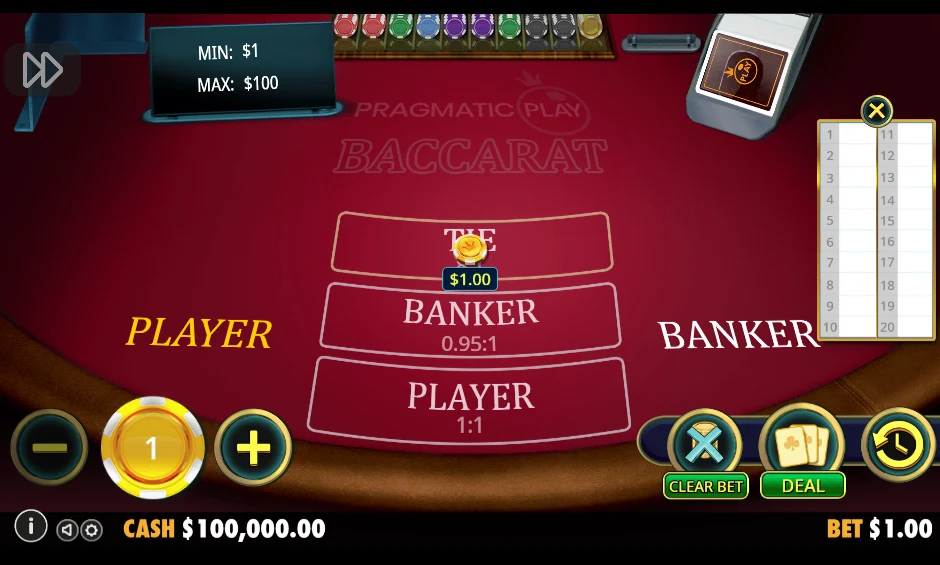
Player, Banker, and Tie look like symmetric options but carry meaningfully different house edges, driven by the mechanics of the Banker’s extra drawing advantage and the standard commission structure.
| Bet | Typical Payout | House Edge |
| Banker | 1:1 minus 5% commission | ~1.06% |
| Player | 1:1 | ~1.24% |
| Tie | 8:1 or 9:1 | ~14.4% (8:1) or ~4.85% (9:1) |
The Banker bet wins slightly more often than Player because of the drawing rules that favour the Banker’s hand in specific third-card situations, which is exactly why a 5% commission is charged on Banker wins – without it, Banker would carry a lower house edge than the casino wants to offer. The Tie bet, despite the appealing payout, carries by far the highest house edge of the three and is generally the weakest value bet at the table.
Common Baccarat Variants
Punto Banco
The standard version found at most online casinos, using entirely fixed drawing rules with no player or banker decisions at all – “Punto” and “Banco” are simply the Spanish/Portuguese-derived names for Player and Banker in this specific variant.
Mini Baccarat
Plays with identical rules to Punto Banco but at a smaller table with a single dealer handling all positions, and usually lower minimum bets – the faster pace common to mini tables means more hands per hour, which affects expected loss over a session even though the per-hand edge is unchanged.
Chemin de Fer
A more traditional European variant where players take turns acting as Banker and have some discretion over drawing a third card, unlike the fixed rules in Punto Banco – rarely offered at online casinos due to this added complexity.
Speed Baccarat
A live-dealer format that compresses the time between hands, often to under a minute per round, aimed at players who want the visual and social elements of live baccarat without the slower pace of a standard live table.
Side Bets in Baccarat
Side bets like Player Pair, Banker Pair, or Perfect Pair pay based on the first two cards dealt forming a pair, independent of the hand’s final outcome. These carry noticeably higher house edges than any of the three main bets, commonly 10% to 11%, since they’re priced around a specific, relatively rare two-card outcome rather than the balanced Player/Banker/Tie structure.
Baccarat – FAQ
Is Banker really the best bet in baccarat?
Statistically yes – Banker carries the lowest house edge of the three main bets even after the standard 5% commission, making it the mathematically strongest option available at the table.
Why does Banker have to pay a commission?
The Banker’s drawing rules give it a slight structural edge over Player in specific third-card scenarios, so the commission brings the effective house edge back in line with what the casino wants to offer, rather than letting Banker win too often relative to Player.
Is the Tie bet ever worth playing?
Rarely, from a pure value standpoint – Tie carries a house edge several times higher than either Player or Banker, making it the weakest of the three core bets despite its larger payout.
Do players make any decisions during a hand?
Only one: which of the three outcomes to bet on before the cards are dealt. Once betting closes, the drawing rules are entirely fixed and no further decisions affect the hand.
What’s the difference between Mini Baccarat and standard Punto Banco?
The rules are identical – the difference is table size, dealer setup, and typically lower minimum bets and a faster pace at mini tables.
Are baccarat side bets worth adding to a wager?
Generally not for value – pair-based side bets carry a noticeably higher house edge than the main Player or Banker bets, since they pay out on a specific, relatively uncommon two-card outcome.