A bitcoin casino is an online gambling platform that accepts BTC, and usually several other cryptocurrencies, as a deposit and withdrawal method, sitting alongside or instead of traditional banking rails like cards and e-wallets. Funds move over the Bitcoin network rather than through a card scheme or a bank’s internal ledger, which changes how deposits clear, how withdrawals are processed, and what a player needs to set up before playing at all.Working out what actually separates a best bitcoin casino candidate from an average one starts with the payment mechanics, not the marketing copy. This guide covers how deposits and withdrawals move on-chain, what confirmation times and network fees look like in practice, how bonus value shifts with coin price, and where the genuine risks sit. It is written as a technical explainer, not a recommendation list.
The list below comes only from cashiers we opened ourselves and captured. As of 6 September 2026 that is two out of ten: Boomerang Bet and RetroBet, and Bitcoin appears in both. The other eight operators have not been checked, so their absence from the list says nothing about them.
Rating a crypto gambling platform is not quite the same exercise as rating a fiat-only site. Licensing still matters a great deal, but so does how a platform handles blockchain confirmations, which coins it genuinely supports versus which it merely lists on a deposit page, and whether its fairness claims can be checked independently rather than taken on trust. A well-run bitcoin online casino separates blockchain confirmation time from its own internal review window clearly, rather than folding both into a single vague “processing time” figure that tells a player nothing useful.
Determines what recourse a player has if something goes wrong
Withdrawal speed
Time from request to blockchain broadcast
Crypto’s main advantage is speed; slow payouts undermine the point
KYC policy
When and how identity checks are triggered
Affects whether “anonymous” claims hold up in practice
Coin support
Number and type of cryptocurrencies accepted
Wider support reduces the need for external conversion
Bonus terms
Wagering requirements, max cashout, game weighting
Determines whether a bonus is realistically clearable
Fairness verification
Availability of provably fair or third-party audited RNG
Lets a player check outcomes rather than trust a claim
Licensing and Safety
Licensing for a crypto gambling site follows the same general framework as any other online casino, issued by bodies such as the Malta Gaming Authority, the UK Gambling Commission, or offshore regulators based in Curacao and Anjouan. The license governs the gambling activity and dispute handling; it says nothing about how well the crypto infrastructure itself is built. Checking the license register directly is a five-minute task that filters out a meaningful share of low-quality online bitcoin casino operators before a deposit is ever made.
Withdrawal Speed, Fees, & KYC Checks
Every casino bitcoin withdrawal has to clear two separate systems before funds arrive: the platform’s own review process, and the network’s confirmation requirement. The first is entirely up to the operator’s risk controls. The second is set by the Bitcoin network itself, running roughly ten minutes per block, with most platforms requiring one to six confirmations before treating a payout as final and irreversible.
Stage
Typical Duration
Notes
Platform review
Instant to 24 hours
Varies by risk flags and account verification status
Blockchain confirmation (BTC)
10 to 60 minutes
Depends on confirmations required and network congestion
Network fee
0.0001 to 0.0005 BTC (variable)
Set by network conditions, not the casino
KYC trigger threshold
Varies, often $2,000 to $5,000 equivalent
Smaller withdrawals may bypass full verification
These figures shift constantly, and comparing top bitcoin casinos on withdrawal speed alone can be misleading without checking current, not historical, data first. Network fees spike when block space is scarce, and a platform’s own review window tends to tighten after it experiences a wave of fraud attempts, so a site that was fast last quarter is not guaranteed to still be fast now.
Accepted Cryptocurrencies
Most crypto casinos accept Bitcoin as a baseline and layer in Ethereum, Litecoin, and a stablecoin such as USDT or USDC on top of it. Litecoin’s shorter block time, roughly a quarter of Bitcoin’s, is one reason many bitcoin online casinos default to it for smaller stakes and faster cashouts. Stablecoins solve a different problem entirely: they remove the price volatility that comes with holding BTC or ETH between deposit and cashout, at the cost of relying on the issuer’s peg holding steady under stress.
Bonuses and Promotions
Bonus structures at a crypto gambling platform largely mirror fiat casino bonuses, but the underlying value is harder to pin down because it is calculated at the exchange rate at the moment of crediting, not at deposit or withdrawal. A new bitcoin casino launching today without at least one stablecoin option is increasingly rare, since volatility exposure during a multi-day bonus clearing period puts off cautious depositors who would rather know exactly what a match is worth.
Bonus Type
Typical Range
Common Restriction
Welcome match
50% to 200% of deposit
Wagering requirement 20x to 50x
Free spins
20 to 200 spins
Restricted to specific slot titles
Cashback
5% to 20% of net losses
Often capped at a fixed BTC amount
Reload bonus
25% to 100%
Usually limited to specific weekdays
A large percentage match sounds appealing on the page, but the actual value of a bitcoin casino bonus depends far more on the wagering requirement attached to it than on the headline figure. A 200% match at 50x is frequently worse in practice than a 50% match at 15x, once the realistic cost of clearing the requirement is worked out against typical stake sizes.
Game Selection & Provably Fair Games
Most bitcoin casino games are licensed from the same handful of studios supplying fiat platforms, Pragmatic Play, Evolution, NetEnt among others, with only a small provably fair category built differently, usually in-house or by crypto-native developers. That distinction matters because the two verification methods are not interchangeable, and knowing which applies to a given title changes how much a fairness claim is actually worth.
Wallet Compatibility
Deposits typically arrive via a generated wallet address unique to the player’s account, sometimes with support for connecting an external wallet such as MetaMask or Trust Wallet for token-based deposits. Getting the network wrong on an online casino bitcoin deposit, sending USDT over Ethereum’s network when Tron was expected, is one of the more common and costly mistakes players make, and it is rarely reversible once broadcast.
Provably Fair Gaming
Provably fair systems work by generating a server seed and a client seed, hashing them together before a round starts, and revealing the server seed afterward so the outcome can be checked against what was committed to in advance. Checking a bitcoin casino online through its provably fair verification tool takes a few minutes and requires no technical background beyond copying a hash value into a checker page.
Verification Method
Applies To
What It Confirms
Provably fair hash
Crash, dice, plinko-style games
Outcome was fixed before the round began
RNG certification
Slots, table games from licensed studios
Random number generator meets independent testing standards
Return-to-player audit
All game categories
Long-run payout percentage matches published figures
Sorting reputable operators from questionable ones is less about marketing claims and more about which casinos bitcoin players can actually verify transactions and outcomes against, hash by hash, rather than simply trusting a badge on the homepage.
Responsiveness to Crypto-Related Queries
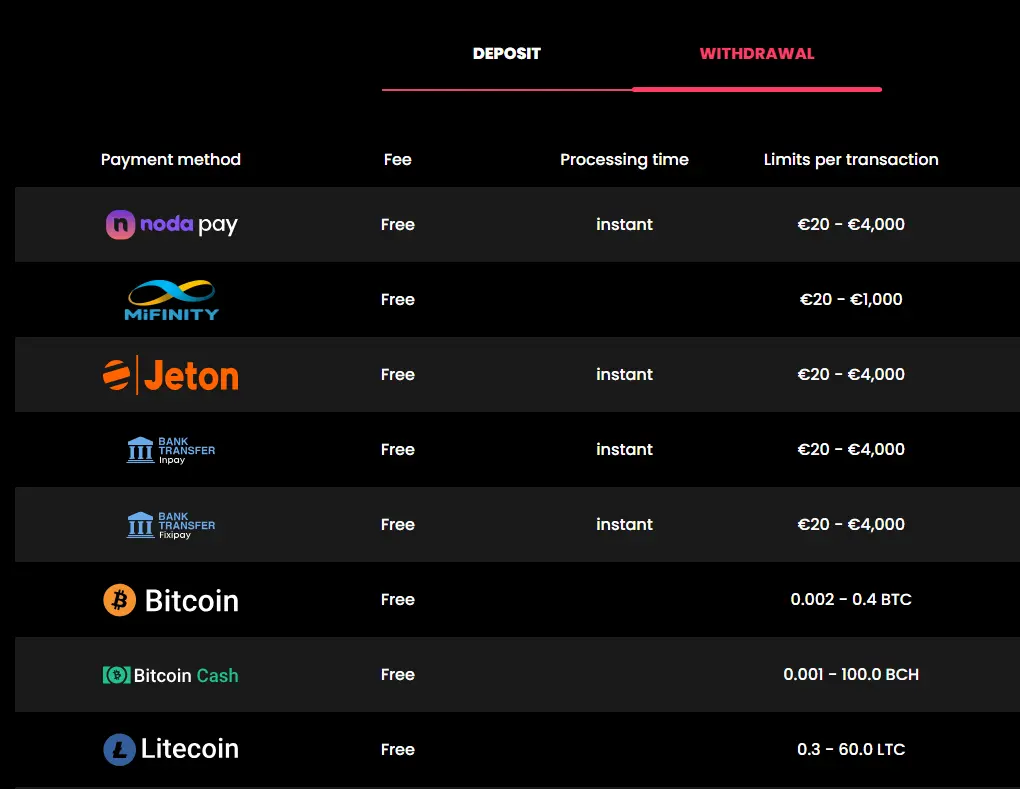
Support quality on crypto-specific issues, wrong-network deposits, stuck transactions, address generation errors, varies more between operators than general support quality does. A support team well-versed in blockchain mechanics can often trace a stuck transaction using the transaction ID; one that only knows the fiat side of the business may just tell a player to wait, which is not always correct or particularly helpful advice.The withdrawal side of a live cashier, 29 August 2026. Every method is free, and the crypto rows carry their own floor and ceiling.
What Are Crypto Casinos and How Do They Work?
A bitcoin casino operates on the same backend logic as any online casino, a game library, an account system, a payments layer, but swaps or supplements the payments layer with blockchain rails. When a player deposits, the platform generates a wallet address, or reuses a permanent one, tied to that account. Once the transaction receives sufficient confirmations on-chain, the balance is credited, either converted to a house currency or tracked directly in the deposited coin depending on the operator’s own setup.Among the factors separating a top bitcoin casino from a mediocre one is how transparently it explains what happens if a deposit transaction receives too few confirmations, or arrives on the wrong network entirely. Withdrawals reverse the process: the platform initiates an outbound transaction from its hot wallet to the player’s specified address. Because blockchain transactions are irreversible once confirmed, there is no chargeback mechanism equivalent to what exists with card payments, which cuts both ways for the player.Comparing an online casino bitcoin deposit to a card deposit highlights exactly where the speed advantage comes from: no intermediary bank has to authorize anything, and no merchant category code flags the transaction for manual review. That said, the operator’s own hot wallet setup introduces a different kind of dependency. Hot wallets are kept online for fast payouts, which is convenient for players but means the platform is holding a meaningful float of funds in a system that is, by design, more exposed than cold storage. Reputable operators keep only a working balance in hot wallets and move the rest into offline storage, though this detail is rarely disclosed publicly and is difficult for a player to verify from outside.Custodial wallet setups, where the casino controls the private keys tied to a player’s balance, are the default across almost the entire sector. Non-custodial arrangements, where a player retains control of their own keys until the moment of a wager, exist but remain uncommon, largely because they complicate instant settlement and odds calculation on the platform’s side. Understanding which model a given site uses matters more than it might first appear, since custodial balances are, functionally, an IOU from the operator rather than funds under the player’s direct control.Deposit addresses themselves are handled in one of two ways. Some platforms generate a fresh, unique address for every deposit, tying it directly to a specific transaction and account. Others assign a single permanent address per account per coin, relying on the memo or the sending wallet’s metadata to match funds to the right player. Permanent addresses are simpler to display in a user interface, but they raise the stakes of network selection errors, since there is no per-transaction safety net to catch a mismatch before funds are credited or lost. Reading the deposit page’s fine print on this point takes thirty seconds and avoids a class of mistake that support teams see constantly.
Pros and Cons of Bitcoin Gambling
Pros
Cons
Faster withdrawals than most bank transfers
Price volatility between deposit and cashout
Lower barrier for players without card access
No chargeback protection if something goes wrong
Often smaller minimum deposits
Network fees fluctuate and are outside the casino’s control
Reduced reliance on personal banking data
Regulatory status still unclear in several jurisdictions
Access to provably fair game verification
Irreversible transactions mean mistakes cannot be undone
None of these points cancel out cleanly, and even the best bitcoin casinos ask players to accept some trade-off between speed and protection. Faster withdrawals matter less if a coin’s value swings eight percent while a KYC review sits unresolved. The honest summary is that bitcoin gambling trades one set of risks, bank restrictions, slower transfers, chargeback fraud, for a different set: volatility, irreversibility, and patchier regulation. It is a different deal, not a strictly better one.Volatility is the risk most first-time depositors underweight. Depositing BTC or ETH and then waiting even a single day before playing exposes the balance to whatever the market does in that window, unrelated to anything happening on the game screen. Stablecoins remove this specific variable by pegging value to a fiat currency, usually the US dollar, though they introduce a different dependency: trust that the issuer holds sufficient reserves to maintain the peg under stress. Neither approach eliminates risk. Choosing between a volatile coin and a stablecoin is really a choice about which category of risk a player is more willing to accept, not a way of avoiding risk altogether.
Types of Casino Bonuses for Crypto Players
Bonus structures at a bitcoin casino follow familiar shapes borrowed from fiat gambling, but crypto-specific quirks change how they are best evaluated, particularly around timing and coin-price exposure. The table below groups the main categories before each is covered individually in more detail.
Bonus Category
Purpose
Typical Wagering Requirement
Welcome bonus
New account incentive
20x to 50x
Reload bonus
Reward repeat deposits
15x to 40x
Free spins
Slot-specific promotion
10x to 40x winnings
Cashback
Partial loss recovery
Usually 1x or none
VIP program
Loyalty-tier rewards
Varies by tier
Many bitcoin casinos publish these terms in a dedicated bonus policy page, though the clarity of that page varies enormously between operators, and some bury the details that matter most several clicks deep.
Welcome Bonuses or Sign-Up Bonuses
Depositing at an online bitcoin casino during a welcome promotion means the match value is locked to that moment’s exchange rate, not to whatever it settles at once wagering requirements clear. A welcome bonus usually matches a percentage of the first deposit, sometimes across a package spanning several deposits, and reading the small print on maximum bonus size matters as much as the headline percentage advertised on the landing page.
Reload Bonuses
Reload terms are usually where a best bitcoin casino distinguishes itself from an operator only interested in first deposits. Reload offers apply to deposits made after signup, typically smaller in percentage than welcome offers and often restricted to particular days of the week, existing to keep deposit activity steady rather than to attract new signups in the first place.
Free Spins
A capped maximum cashout on free spins is one of the more overlooked details of casino bitcoin bonus terms, and it can turn what looks like a large win into a modest one once the cap applies. Free spins are tied to specific slot titles chosen by the operator, not the player’s own preference, and winnings from them almost always carry a separate wagering requirement from any deposit bonus running at the same time.
Cashback Bonuses
Cashback percentages at different bitcoin casinos are rarely published as a flat, guaranteed figure; most scale with total deposit history and account tier. Cashback returns a portion of net losses over a set period, weekly or monthly, either as bonus funds with light or no wagering requirements attached, or occasionally as withdrawable balance for higher-tier accounts.
VIP/Loyalty Programs
Reaching the top tier at a bitcoin online casino loyalty program can take months of consistent play, and some tiers are invitation-only regardless of how much volume a player generates. VIP programs track deposit volume and wagering activity to assign tiers, each unlocking better cashback rates, dedicated support contacts, and sometimes personalized withdrawal limits above the standard cap.
Tournaments & Leaderboard Bonuses
Leaderboard formats are common even among smaller best bitcoin casinos precisely because the total prize pool is fixed in advance regardless of how many players enter. Tournaments rank participants by wagered volume or net wins on designated games over a fixed window, with prizes split among top finishers, making them lower-risk from the operator’s side than open-ended promotions.
Exclusive Crypto Deals
Short-lived promotions tied to a specific coin are one of the more genuinely distinct features of online casino bitcoin marketing compared to fiat equivalents. Some operators run deals tied to depositing during a particular coin’s price movement, or a flat reward for using a less common network such as Solana or Tron instead of Bitcoin or Ethereum directly.
Best Bitcoin Casino Bonuses
Identifying the best bitcoin casino bonuses on paper means comparing match percentage, wagering requirement, and maximum cashout together, never any single figure in isolation. Ranking bonuses across bitcoin casinos fairly means normalizing for wagering requirement and cap, not just comparing headline match percentages that look impressive but hide unrealistic clearing conditions underneath.
Terms & Conditions
Reading the fine print before opting into any bitcoin casino promotion avoids the common mistake of assuming all wagered volume counts equally toward clearing it. Slots often count 100% of wagers toward a requirement, while table games and live dealer titles may count 10% or less, a difference that changes the realistic cost of clearing a bonus substantially.
Top Crypto Gambling Games
Game categories at a bitcoin casino split roughly into licensed studio titles and blockchain-native formats built around verifiable fairness. Both groups are covered below, starting with a summary table of verification methods and typical house edges.
Game Type
Verification Method
Typical House Edge
Slots
RNG certification
2% to 6%
Blackjack
RNG certification (or live dealer)
0.5% to 2%
Crash
Provably fair
1% to 3%
Dice
Provably fair
1% to 2%
Poker (RNG variants)
RNG certification
Varies by format
Slot percentages published by top bitcoin casinos are long-run averages calculated over millions of rounds, not a guarantee for any individual session a player happens to sit down for.
Crypto Slots
Volatility and payout structure at most bitcoin online casinos come directly from the studio’s own configuration, unrelated to the payment method used to fund play. Slot titles at a crypto-friendly site are typically identical to those on fiat platforms, licensed from the same studios and running the same certified RNG behind the scenes.
Table Games
Blackjack, roulette, and baccarat appear in both RNG-based and live dealer formats. RNG versions rely on certified random number generation; live dealer versions are streamed from physical or studio tables, which removes RNG concerns entirely but introduces stream latency as a separate consideration worth checking before committing to higher stakes.
Poker
Poker splits between RNG-driven video poker, which functions like a slot with fixed odds and pay tables, and multiplayer formats against other players, which behave more like standard online poker with rake taken by the house rather than a fixed statistical edge built into every hand.
Live Dealers
Live dealer games stream a real dealer and physical equipment to players in real time, funded and settled the same way as any other game on the platform. The main practical difference for a crypto depositor is that live tables often carry higher minimum stakes than their RNG equivalents do.
Crash Games
Crash formats are frequently the centerpiece of a bitcoin casino bonus built around a specific in-house title rather than a licensed slot from an external studio. A rising multiplier climbs until a player cashes out or it randomly stops, with the stopping point generated and hashed before the round begins under a provably fair system that can be checked afterward.
Provably Fair
Independent verification is one advantage even modest best bitcoin casinos can offer that a purely fiat platform generally cannot, since there is no blockchain-adjacent hash to check against on a card-funded site. As a category, provably fair games are grouped together because they share the seed-hash verification model, trading visual complexity for a mechanism a player can actually audit.
Are Bitcoin Casinos Legal?
Whether a bitcoin casino is legal for a specific player depends entirely on local law, and no general guide can substitute for checking it directly against current regulation. Some regulators treat crypto gambling the same as fiat gambling and license it accordingly; others have no specific framework yet, leaving platforms operating in a gray area; a smaller number restrict or prohibit it outright, and enforcement varies as much as the rules themselves.Three broad regulatory patterns show up repeatedly across markets, without pinning any of them to a specific country. The first treats online gambling, crypto-funded or not, as a licensed activity subject to the same consumer protection rules as any other financial product. The second has simply not caught up to crypto-funded gambling specifically, applying older fiat-era rules unevenly or not at all. The third treats most or all online gambling, regardless of payment method, as restricted or prohibited, in which case the payment method is beside the point. A player’s obligation to check local law does not disappear because a platform is willing to accept a deposit; accepting the deposit and the transaction being lawful for the depositor are two separate things.
Are These Casinos Safe?
Safety is a separate question from legality entirely. A licensed operator based in a gray-area jurisdiction can still run honest, well-audited games; an unlicensed one in a fully regulated market can still be a scam. License status, audit history, and payout track record are better safety indicators than jurisdiction alone, and none of them should be checked in isolation.Independent RNG certification from a recognized testing lab, published payout percentages by game, and a visible history of processing withdrawals without repeated delays together form a more reliable picture than any single badge or claim. Community feedback on independent forums, weighted toward recent posts rather than old ones, tends to surface withdrawal problems faster than official review sites do, since forum users have no commercial relationship with the operator being discussed.
Are BTC Gambling Sites Really Anonymous
Bitcoin transactions are pseudonymous, not anonymous, and the distinction matters more than marketing copy usually admits. A bitcoin online casino that skips identity checks at signup does not make the underlying blockchain transaction untraceable; the ledger itself is permanent and public, and wallet addresses can be linked back to a person through exchange KYC records, IP metadata, or straightforward on-chain analysis.
Do These Casinos Require Document Checks?
Most licensed operators require identity documents at some point, usually triggered by a withdrawal above a set threshold rather than at signup itself. A platform advertising no KYC at any stage is either operating without meaningful licensing oversight or applying undisclosed limits that surface later, and neither situation is a particularly good sign for a new depositor.
How to Tell if a Bitcoin Casino is a Scam
A few patterns recur across fraudulent operators, and none of them require technical expertise to spot. No visible license number, or one that fails to resolve against the regulator’s public registry. Withdrawal terms that shift only after a win is requested. Bonus terms so aggressive that clearing them was never realistically achievable to begin with. Comparing patterns across scam reports shows the same red flags recur regardless of jurisdiction, and even some best bitcoin casinos have had to publicly warn players about fake clones impersonating their own branding.A new bitcoin casino with no track record deserves extra scrutiny simply because there is no withdrawal history to check against its promises, no forum threads from past players, and no complaint pattern to search for. This is not a reason to avoid every new operator automatically, some are perfectly legitimate and simply new, but it is a reason to start with a small deposit and a small withdrawal test rather than committing significant funds on day one, and to treat unusually generous welcome terms with more suspicion than a modest, clearly explained one.A few additional checks worth running before depositing anything meaningful:
Search the operator’s name alongside terms like “withdrawal delayed” or “account closed” to surface recent player complaints.
Confirm the license number against the regulator’s own public database rather than trusting the badge shown on the casino’s page.
Check whether the site discloses its company registration details, not just a brand name and a logo.
Read the maximum withdrawal limit per day, week, or month, since a low hidden cap can turn a real win into a slow, frustrating trickle of payouts.
Expert Tips for Playing at Crypto Casinos
Verify the license number directly on the regulator’s website rather than trusting a badge displayed on the casino’s own page, since badges can be copied without authorization by anyone. Read the wagering requirement and game weighting before opting into any bonus, not after depositing. Testing a small payout before committing larger deposits is standard advice for any casino bitcoin transaction, not a crypto-specific quirk. Double-check the network selected for any token deposit against what the deposit page specifies, since sending on the wrong network can mean permanent, unrecoverable loss of funds.A few further habits reduce avoidable losses that have nothing to do with the games themselves. Screenshot or save the transaction ID for every deposit and withdrawal, since a support team will ask for it if anything gets stuck, and having it ready saves a back-and-forth that can otherwise stretch a resolution out by days. Avoid keeping a large balance sitting in a casino’s custodial wallet longer than necessary; withdrawing winnings promptly limits exposure to platform risk, not just market volatility. If a stablecoin option exists and the plan is to play over several sessions rather than one sitting, using it removes a variable that has nothing to do with skill or luck.
Responsible Gambling
Cryptocurrency’s speed and reduced friction can make it easier to deposit repeatedly without the natural pause that a bank transfer or card authorization sometimes introduces into the process. Most licensed operators offer deposit limits, loss limits, and self-exclusion tools, and using them proactively is worth doing regardless of how controlled a player’s gambling feels at the time. Setting a limit before a session starts, rather than deciding mid-session, is a small habit that consistently correlates with lower reported harm in problem gambling research, and it costs nothing to put in place on day one.If gambling is causing financial, relationship, or emotional strain, organizations such as GamCare, BeGambleAware, or the National Council on Problem Gambling provide free, confidential support to anyone who reaches out, regardless of which payment method was used to fund the activity. Self-exclusion tools at reputable operators typically extend across a group of affiliated brands, not just the single site being used, which closes an obvious workaround that a single-site block would leave open.
FAQs
Why should I play at Bitcoin casinos?
The main practical draw is withdrawal speed and reduced dependency on card or bank approval, which matters most to players who have previously had gambling transactions blocked by their own bank. It is not inherently safer or fairer than fiat gambling, just structured differently around a different payment rail.
What is the best crypto casino?
There is no single best crypto casino for every player, since the right choice depends on preferred games, coin support, and jurisdiction-specific licensing. Comparing licensing, withdrawal speed, and bonus terms side by side is more useful than relying on any single ranking found online.
Can I access generous welcome bonuses at crypto online casinos?
Welcome bonuses are common and can be sizable, but a large headline percentage often comes with a correspondingly high wagering requirement attached. Checking the requirement and any maximum cashout cap matters more than the match percentage alone when judging real value.
Are crypto casinos licensed?
Many are, holding licenses from bodies such as the Malta Gaming Authority, the UK Gambling Commission, or Curacao’s regulator, though standards and player protections vary significantly between these. Some platforms operate without any license at all, which is worth checking before depositing anything.
Can I use crypto casinos on my mobile device?
Most operate through mobile-optimized browser sites rather than dedicated apps, since app stores restrict real-money gambling applications in many regions. Wallet connections and QR-code deposits generally work the same way on mobile as they do on desktop.
Are Bitcoin casinos fair?
Fairness depends on the specific game and verification method used at the time. Provably fair titles can be independently checked by the player directly; licensed slots and table games rely on third-party RNG certification instead, which requires trusting the auditor rather than verifying each round on the spot.
What is the minimum deposit at a Bitcoin casino?
Minimum deposits are often lower than fiat equivalents, sometimes as little as ten to twenty dollars in crypto value, though network fees can make very small deposits impractical once costs are factored into the total.
Can I win real money at crypto casinos?
Yes, winnings are real and withdrawable, subject to the same wagering requirements, KYC checks, and withdrawal processing that apply to any other deposit method available. The odds and house edge are set by the games themselves, not by the payment method used to fund them.
What is RTP in crypto gambling?
Return to player, or RTP, is the theoretical long-run percentage of wagered funds a game pays back, calculated over millions of rounds rather than any single session. It applies identically regardless of whether the game is funded with crypto or fiat currency.
Do you pay taxes on crypto gambling winnings?
Tax treatment depends entirely on the player’s local jurisdiction and is not something a general guide can answer definitively for every reader. Consulting a local tax professional is the only reliable way to determine reporting obligations on gambling winnings received in cryptocurrency.
A list of casinos accepting this payment method will appear here.