Payment method
Casino Payment Methods in 2026
Choosing between different ways to fund an account is one of those decisions players tend to skip until something goes wrong: a card gets declined, a withdrawal sits “pending” for four days, or a bonus turns out to exclude the deposit method they just used. This page looks at how payment methods for online casinos actually work in practice in 2026, what separates a fast route from a slow one, and where the trade-offs sit between convenience, cost, and privacy.
None of this is exciting reading, and it isn’t meant to be. It’s the operational layer underneath the games, and it’s worth understanding before money moves anywhere. We’ve kept the focus on category-level information rather than promises tied to any single operator, since how a payment method behaves depends as much on the bank or provider as it does on the casino itself.
Best Online Casino Payment Methods List in 2026
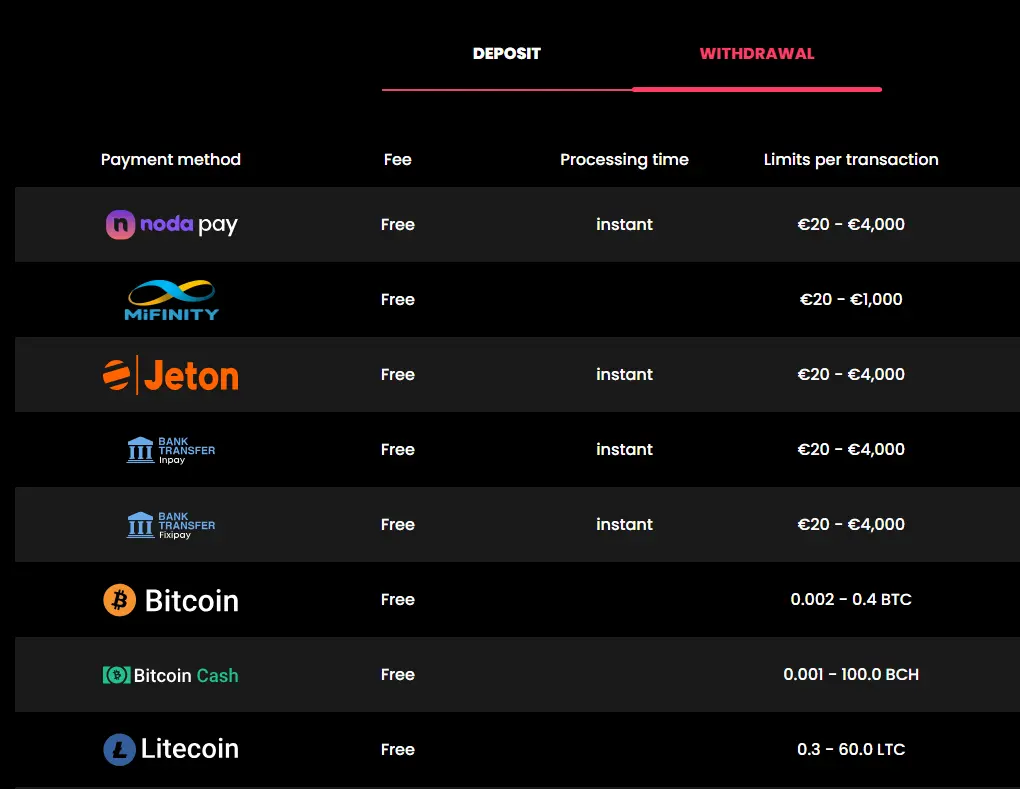
How We Ranked Casino Payment Methods
Ranking payment methods for online casinos isn’t a single-metric exercise. Speed matters, but a fast method with high fees or poor dispute protection isn’t automatically the better pick. The table below sets out the criteria we weighed and roughly how much each one factored into the overall assessment of the best online casino payment methods covered on this page.
| Criterion | What it covers | Why it matters |
| Deposit speed | Time from initiating a deposit to funds showing in the casino account | Most methods are instant, but confirmation delays do happen |
| Withdrawal speed | Time from a withdrawal request being approved to funds arriving | Ranges from minutes (crypto, some e-wallets) to several business days (bank transfer) |
| Fees | Deposit and withdrawal charges from the payment provider, separate from any casino fee | Not always disclosed clearly upfront |
| Availability | How widely the method is supported across licensed operators | Some methods are accepted almost everywhere, others are niche |
| Security and disputes | Chargeback rights, buyer protection, fraud liability | Cards and e-wallets typically offer more recourse than crypto or bank transfer |
| Limits | Minimum and maximum deposit or withdrawal amounts | Relevant for both casual players and higher-stakes users |
None of these criteria work in isolation. A payment method for online casinos that’s instant on deposit but slow on withdrawal is common, and it’s the withdrawal side that tends to frustrate players more, since that’s the point where patience runs thinnest. There isn’t a single best casino payment methods answer that suits everyone; the criteria above are meant to help weigh trade-offs against individual priorities, not to crown one winner.
Terminology in this space is inconsistent, which is worth flagging. One review site labels this section casino online payment methods, another files it under payment methods casino, and a third goes with payment methods online casinos or casinos payment methods. Search listings also throw in phrasings like online casino payment method and payment method of online casino. None of it changes what’s actually being described: the deposit and withdrawal options available for real-money play.
Choosing Payment Methods for Online Gambling
There isn’t a universally “best” option among payment methods for online casinos. Cards are familiar and widely accepted but come with bank-side restrictions in some regions. E-wallets are quick and keep bank details separate from the casino, but not every operator supports every wallet. Crypto is fast and low-fee once set up, but volatility and technical friction put some players off entirely. The right pick usually comes down to priorities: speed, privacy, dispute protection, or simply what’s already sitting in an account.
| Method | Typical deposit time | Typical withdrawal time | Typical fees |
| Credit card | Instant | 1-5 business days | Usually free to deposit; cash advance fees possible |
| Debit card | Instant | 1-5 business days | Usually free |
| Prepaid card | Instant | Not usually supported for withdrawal | Purchase fee from the card issuer, no casino-side fee typically |
| E-wallet | Instant | Minutes to 24 hours after approval | Occasional withdrawal fee, from 0-3% |
| Cryptocurrency | 10-60 minutes (network dependent) | Minutes to a few hours after approval | Network fees only, usually low |
| Bank transfer | Same day to 1 business day | 1-5 business days | Free or flat fee depending on bank |
Credit card
Credit cards remain one of the most recognisable entries among online casino payment methods, mainly because setup takes seconds and most players already have one. Deposits clear instantly in nearly all cases. Withdrawals back to a credit card are a different story: some processors don’t support it at all, redirecting refunds to a different method instead. That’s worth checking before assuming a withdrawal will land back where the deposit came from.
Credit card gambling transactions are treated as cash advances by some card issuers, which can trigger higher interest rates from the moment the transaction posts. This is a card-issuer policy, not a casino one, and it varies by bank rather than by operator.
Debit card
Debit cards work almost identically to credit cards from the casino’s side, but the money comes straight from a checking account rather than a credit line. That makes debit a lower-risk choice for players who want to avoid interest charges or cash-advance fees. Deposit limits are usually tied to the card’s daily spending cap rather than anything the casino sets.
Withdrawal speed for debit cards mirrors credit cards, generally landing within a few business days once the casino approves the request. Refused transactions do happen, usually from the issuing bank rather than the casino, and there’s rarely a clear explanation given at the point of decline.
Prepaid card
Prepaid cards are a niche but persistent option. They let a player load a fixed amount and spend only that, which some find useful for budgeting. No bank account or credit history is required, which matters if someone would rather not link gambling activity to a primary account.
The limitation is withdrawals. Most prepaid cards can’t receive funds back, so players using this method usually need a second payment method on file for cashouts. It’s a deposit-only tool in most cases, not a two-way channel.
E-wallet or mobile wallet
E-wallets sit in the middle ground: faster than cards on withdrawal, and they keep card or bank details away from the casino directly. Setup usually takes a few minutes the first time, and after that deposits and withdrawals are close to instant once approved. Support varies by operator though, and not every wallet is accepted everywhere.
Some e-wallets exclude gambling-related bonuses even when the wallet itself is accepted for deposits, which is a detail easy to miss until a bonus doesn’t apply. Reading the terms tied to a specific promotion matters more here than with cards.
Cryptocurrency
Crypto has moved from fringe to fairly mainstream among the payment methods for online casinos covered here, largely because of speed and low fees once a wallet is funded. Bitcoin, Ethereum and a handful of stablecoins are the most commonly supported. Network confirmation times vary, and fees spike during network congestion, so “fast and cheap” isn’t guaranteed every time.
The trade-off is volatility on non-stablecoin transactions and a steeper learning curve for anyone setting up a wallet for the first time. There’s also less regulatory recourse if something goes wrong compared to a card chargeback, so this method suits players comfortable managing that risk themselves.
Bank transfer
Bank transfer is the slowest common method on this list, but also one of the most trusted for larger amounts. Deposits can clear the same day, though withdrawals routinely take several business days since both the casino’s bank and the player’s bank need to process the transaction. For high-value withdrawals, it’s still often the default because limits tend to be higher than other methods.
Fees vary by bank rather than by casino, and some banks flag gambling-related transfers for manual review, which adds delay on top of standard processing time. It’s not the method to pick if speed is the priority.
Responsible Gaming
Payment method choice intersects with responsible gaming more than players often realise. Instant methods like e-wallets and crypto make it easy to deposit again quickly after a loss, with no natural pause built in. Slower methods like bank transfer create a bit of friction, which for some players is genuinely useful as a brake.
Deposit limits, self-exclusion tools and reality checks are available on licensed platforms and are worth setting up before, not after, a session gets away from someone. None of the payment methods discussed here are designed with restraint in mind. That’s on the tools and the player, not the payment rail.
Casino Payment Methods FAQ
A few recurring questions come up around payment methods online casino support, mostly about speed, fees and what happens when something goes wrong.
Which casino payment method is fastest for withdrawals?
E-wallets and cryptocurrency are typically the fastest once a withdrawal is approved, often landing within a few hours. Cards and bank transfers usually take several business days because more institutions are involved in processing the request.
Are online casino payment methods free to use?
Deposits are usually free across most methods. Withdrawal fees are less consistent and depend on the specific provider, with e-wallets and some bank transfers more likely to carry a small charge than debit cards.
Can I use a different payment method casino operators offer for withdrawal than I used for deposit?
Sometimes, but not always. Many operators require deposits and withdrawals to go through the same channel where possible, partly as an anti-fraud measure. Prepaid cards are the clearest exception since they can’t usually process withdrawals at all.
Is cryptocurrency safe to use for online gambling deposits?
It’s fast and low-fee, but it carries different risks than cards, mainly volatility and the absence of chargeback protection. Whether it counts as “safe” depends on how comfortable a player is managing a wallet and accepting those trade-offs.
Why was my card declined at an online casino?
Declines usually come from the issuing bank rather than the casino, often because the bank blocks gambling-coded transactions by default. Contacting the bank directly is usually more productive than contacting casino support in this situation.
Do payment methods affect bonus eligibility?
Yes, in some cases. Certain e-wallets and prepaid cards are excluded from specific promotions, which is stated in the bonus terms rather than in general payment information. It’s worth checking before assuming a deposit method qualifies.
What’s generally considered the best payment method casinos support for large withdrawals?
Bank transfer tends to have the highest withdrawal limits, which makes it the practical choice for larger amounts even though it’s slower than e-wallets or crypto. Some operators also raise limits on card withdrawals for verified, long-standing accounts.
- Boku Casinos: Pay by Phone Bill in 2026Boku is a mobile billing service that lets a player fund an account using their phone bill or…
- Crypto Casinos to Play in 2026A crypto casino is a gambling site that accepts cryptocurrency as a funding method, either alongside traditional cards…
- Neteller Casino Sites 2026Neteller is one of the older e-wallets still active in online gambling, owned by the same parent company…
- PayPal Casino – Sites That Accept PayPal 2026PayPal has been available as a deposit option at gambling sites for years in some markets, and it…
- Paysafecard Casinos in the 2026Paysafecard works differently from most other payment methods used at gambling sites. It's a prepaid voucher, purchased with…
- Payz Casinos: Deposit and Withdrawal Times in 2026Payz is the rebranded name for what used to be known as ecoPayz, an e-wallet that's been used…
- Skrill Casinos: Deposit and Withdrawal Speed in 2026Skrill has been part of the online gambling payment stack for close to two decades, and it hasn't…
- Trustly Casinos: Instant Bank Transfers Without a CardTrustly has become one of the more common ways to move money into and out of an online…